Sunday, July 27, 2008

Saturday, January 19, 2008
Operation Potent Wind Progress Report

Our first step toward eliminating the cap was to double it to B$ 50K. We decided that this would be healthier for the game than simply letting things float, as it would give players time to adjust to the new conditions. The chart below shows the end state distribution after this change -- about 75% of the formerly capped blogs were now at their "natural" state.

At this point, we had originally planned to implement a new algorithm for blog link value, and eliminate the cap, but I felt there was additional value to be gained in stretching out the transition. The next chart shows the impact on outgoing link values seen from increasing the limit to B$ 100K - we get even closer to a true power law, but it's possible there is still more room for improvement.

Looking at the 700 or so blogs stuck at the outgoing link limit, we can see that over half have no outgoing links, and only 112 have more than a single outbound link. This means that we are probably at the point of diminishing returns, and don't need another step in outgoing link value before moving on to Phase 2.

One final chart in this post - the daily valuation of the total blogs market since we started Potent Wind. For the first week or so of Phase 1, you can see a generally stable trend, followed by a huge leap on January 6th. In the early part of the project, we allowed blog values to propagate naturally as players indexed their blogs. This effort concentrated on the few hundreds of blogs with the most value, and gave us a relatively stable market value for the first time in recent memory.

On January 6th, we fed the remaining capped blogs directly into the spiders, and realized a huge leap in overall blog value. We then let things settle for another week, and raised the cap again. You can see from the chart that blog valuation appears to be accelerating upward, with a glitch on January 1th caused by the elimination of a top-5 blog from the game.
Our next step will be to introduce the new algorithm for outgoing link values. We will be removing the limits, and players should see a whole new class of blogs grow in value.
Saturday, November 10, 2007

Tuesday, October 30, 2007
Chances
The contest has more than tripled the rate at which chances is played, as you can see in the graph (click to enlarge).

Sunday, September 30, 2007
Yoga
Abigail @ Livejournal
Yoga Powers
Ashtanga Voices NYC
Museless Musings
SacredByDesign's Photos
Stretch and the City
Gretchen Robinson's Yoga Blog
Take a Grip
ExpressionEngine Expressions
Give them a read, you might learn something interesting.
Friday, August 03, 2007
2,300 Chippies Contest # 23
Blogshares provides a wide range of ways to interact with other players, besides the normal buying and selling of shares, ideas, and chips. For direct communication, one can use private messaging in the game, post on the forums, or chat in numerous IRC channels on WyldRyde. This wide range of options allows for all sorts of fun and interesting things, ranging from making complicated deals to corporate gang warfare.
The latest competition, 23rd in the series, is huge, with logic puzzles, math problems, game play, and of course the number 23 playing roles. Complex submission rules make the game challenging, while questions like “Explain why or how 20880467999847912034355032910567 is both 23 and 32” make it fun. With the bonus of annoying AXA, you’ll have a great time playing along with Rantz and the rest of the 2,300 Chippies Corporation!
Tuesday, July 10, 2007
Non-Premium Shares Strategies
1) Snatch up unowned blogs. Got artefacts? Use them. Go through the industries on your arte list, searching them for unowned blogs (I find Firefox's "find" function particularly useful for this). Hit them with a pressure public to buy the shares at one third of the normal price (if they're above P/E 60, PRD them first. No-one owns them, so no-one will care).
I've been doing a lot of this recently, packaging them up into parcels of a billion B$, and passing them on. I'll have another lot ready in a week or two, BTW, so if anybody wants it (who hasn't already had such a package), drop me a line.
2) Loot the dead. Look for players who have not logged in for a while (I have a list), and use your artefacts to ream out their portfolios. For this sort of thing, I tend to PRD until the P/E is < 40, then restructure and HTO. Again, they're dead, so no-one will mind.
3) If you prefer a more vigorous style of play, look for high value blogs with low P/E and steal them with restructure and HTO. They may be stolen back, or they might not be, but you'll probably make a profit. Try to avoid "friendly fire" while doing this, and remember not to steal from Robber Barons or their ex-members who are still abiding by the truce.
A good thing to do here is maintain a dead list, and sort by P/E. I do this with a folder called "Reposessed" - basically those high-value blogs which have passed through my portfolio in the past. Every time I log on, I check to see whether anything is at the top, and steal it. Most gets taken back, but its a constant source of revenue.
4) You can also loot the living, but this tends to upset people. At the moment, I'm trying to avoid doing it too much, except on the ultra-high-value (B$1,000,000+) blogs, where its a great way of making money.
Note that all of these are artefact-based strategies - so if you don't have any artes, acquire some. The cheap ones are well worth it. The expensive ones (those with ideas valued at over B$1000) don't really (or at least not through shares play), and are of interest mainly for ideas play and collectors.
Also note that the daily transaction limit doesn't apply to artefact play, so once you've made your 20 buy / sells, you can use artefacts to your heart's content to build your portfolio.
Idiot Savant is an excellent shares player, and has amassed a portfolio worth B$ 11.5 billion. You would do well to follow his advice.
Saturday, June 30, 2007
Growing Shares Portfolio for Non-Premiums
First, you need to know that artefact-based share transactions don't get limited by the 21-turn-per-day restriction. Restructure, Hostile Takeover, and Pressure Public are great tools for acquiring blog wealth.
If you have more than 750 Karma, any vote you place on a blog automatically puts it into the industry you voted. You can use this tactically to your advantage, because each artefact has the potential to buy two different blogs in a day (if you could find ones in the right industries). If you aren't at 750 Karma yet, vote well and vote often to get there. This tactic still works, but takes more time and is limited to once per day.
One more important piece of information: when you buy a blog from the market (limited to 25% of the existing shares at one time), the price-to-earnings ratio goes up one step. When you acquire all of the shares in the blog through a Pressure Public artefact use, the P/E ratio will continue to increase every 15 minutes for about the next 2 hours. A fresh blog starting at about 1.0 P/E should end up around 80 or so.
So here's a strategy using the above information:
1) Go to the following pages and look for blogs with a low P/E and available shares:
-- Stock Tips (the current lowest P/Es in the index)
-- Lowest Priced Shares (10 lowest priced blogs)
2) Pressure public on the blogs you find, to get the available shares off the market. Look at the transactions on this blog for an example, where I just did a Pressure Public. Note how the share price increases in 8 increments, each about 15 minutes apart.

3) If you find one you want to take away from someone, use Restructure until you get 20% ownership -- usually 2 times -- then do a Hostile Takeover. Avoid doing this on blogs where the blog owner has a significant stake (> 50%), because it's hard to get the shares needed for a takeover. I just did this on this blog, and it took 4 Restructures to get over 20%.

In this case, the blog had recently crashed and was at less than B$ 0.01 per share, so the move looks pretty small, but with one hype in there I was able to get the price up over B$ 0.72, which is almost 100 times what I paid for it.
Note what happens to the price in the 2 hours after my takeover of each blog -- pretty spectacular rise in value (after a slow start).
This whole strategy works best if you have a lot of artefacts. Vote and Moderate industries (if you have enough Karma) to get chips, which you can sell for cash. Use the cash to buy ideas for the artefacts you don't own yet. You can win chips, ideas and artefacts playing chances. You win shares in blogs too, but those are usually dead blogs not worth holding -- report the dead ones for more sigma, plus 20 chips each.
Try this whole pattern for a week or so, and watch your portfolio grow. I'll bet you can double your holdings in less than that time.
Tuesday, April 17, 2007
What's Happening with Ideas?


The effect on player wealth has not been as severe. Has the new math run into a theoretical limit, or does this indicate a flight of wealth from ideas into some other vehicle, like corporate investment?
Saturday, February 24, 2007
The New Math - a longer term view
When management turned on the new math, they decided to limit one of the factors, known as D1, because it had a bit too much power. D1 is the ratio of idea market value to total player wealth, and it sat at 0.9790. A week later (shortly after this post), it had fallen to 0.6125, and many players were convinced that the sky was falling.
Fortunately, the market correction ended and values started to climb again. In fact, player wealth tends to lead the idea market now, showing that it is certainly possible to make money in a down market. In the months since implementing the new math, the game has gone through several cycles, as management has eased the throttle on D1's impact. The chart below shows what an interesting ride it's been.

Despite the initial nervousness, players seem to have adapted well to the new math. The chart below shows that the cycles in D1 effectivity, while seemingly painful while going on, are actually becoming less of a challenge. In fact, the cycle just completed on 05 Feb saw an increase in player wealth.

Blogshares always seems to be looking for a way to keep the game interesting, and to keep players coming back for more. Its challenge is in the depth and breadth of the game, as you can see from this one tiny sliver of the game.

Sunday, October 01, 2006
Idea Market Skid

Saturday, September 16, 2006
New Math - Three Weeks In

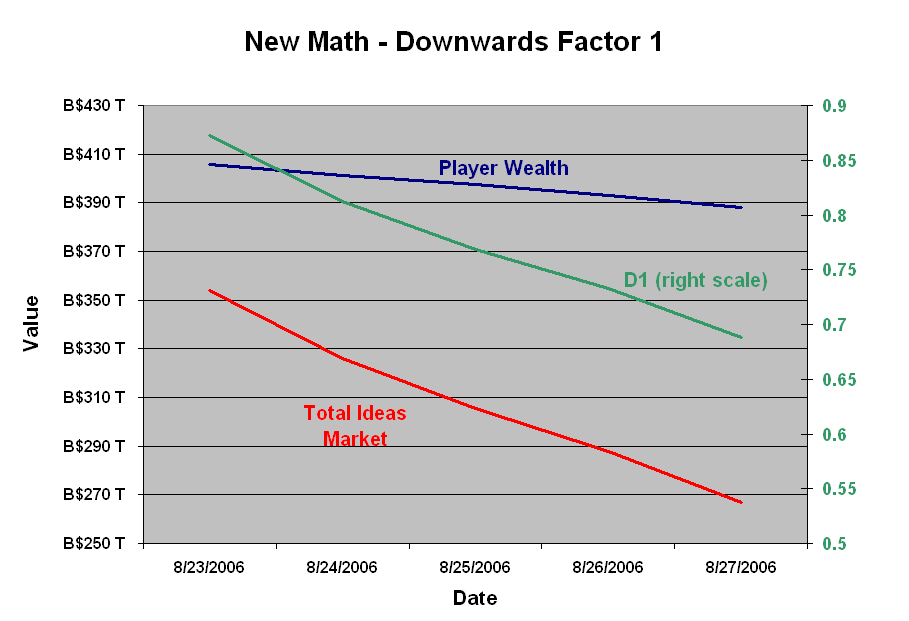
The new math was introduced with two factors, D1 and D2, to put downward pressure on the ideas market. D1 - the proportion of total player wealth tied up in ideas - works on the market as a whole, while D2 works on the individual industries.
Initially, the new math did a phenomenal job, deflating the ideas market by at least B$ 110 trillion (27%) in the first week. As you can see on the graph below, the fall was swift, and quite painful for some players who had not protected their portfolios. With D1 above 0.65, the general downward force clearly dominated the market.

But then, on the 29th, it looks like something happened. The fall abruptly stopped, as if someone had flipped a switch. Total player wealth started to grow, so the downward pressure continued, but it only held things level. Could 0.65 in D1 be a key turning point to watch in the future?
In the next graph, you can see another inflection point on September 2nd, when the idea market started to rise. It hasn't looked back since, and we now have an ideas market that is B$ 50 trillion larger than it was on the 23rd of August. The downward force, at this point, appears to be just along for the ride, as the upward forces generated by players indexing rare industries rule the day.

Under the old math, industries rose or fell linearly, based on the rarity of their ideas. It was clear from their price histories which would rise, which would fall, and which would remain flat. Now, industries rise and fall based on the actions taken in the market. The Activism industry is a prime example:
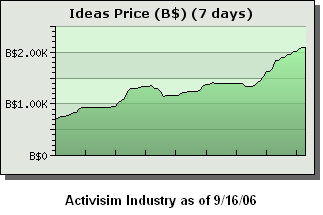
In all, I think these changes are good for the game, and will probably help improve the index on which the game is based. Industries will be refreshed by players in search of bargains, and players with small stakes will have the opportunity to grow them by making the right trades.
The only question remaining is how far this will go. As seen in the graph below, the rate of growth in the ideas market is accelerating, well beyond the 1-2% levels under the old algorithm.

Will the game administrators allow it to get out of hand, or will some additional market corrections get applied in the future? The only way to find out is to play the game.
Sunday, September 03, 2006
Sunday, August 27, 2006
New Math Downward Force
Here's the chart for the first few days, based on the data available here and captured over the last few days:
Monday, August 21, 2006

Tuesday, July 18, 2006
Monday, July 03, 2006


Saturday, July 01, 2006
Wow!
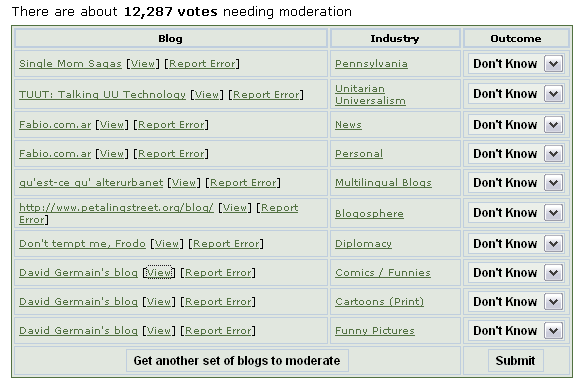
This has got to be a first -- a moderation screen with zero-zip-nada-zilch MSN Spaces "blogs" listed. Yay!

